Sediments of Time

“Nothing disappears completely. In space, what came earlier continues to underpin what follows. Pre-existing space underpins not only durable spatial arrangements, but also representational spaces and their attendant imagery and mythic narratives.”
— Henri Lefebvre, The Production of Space
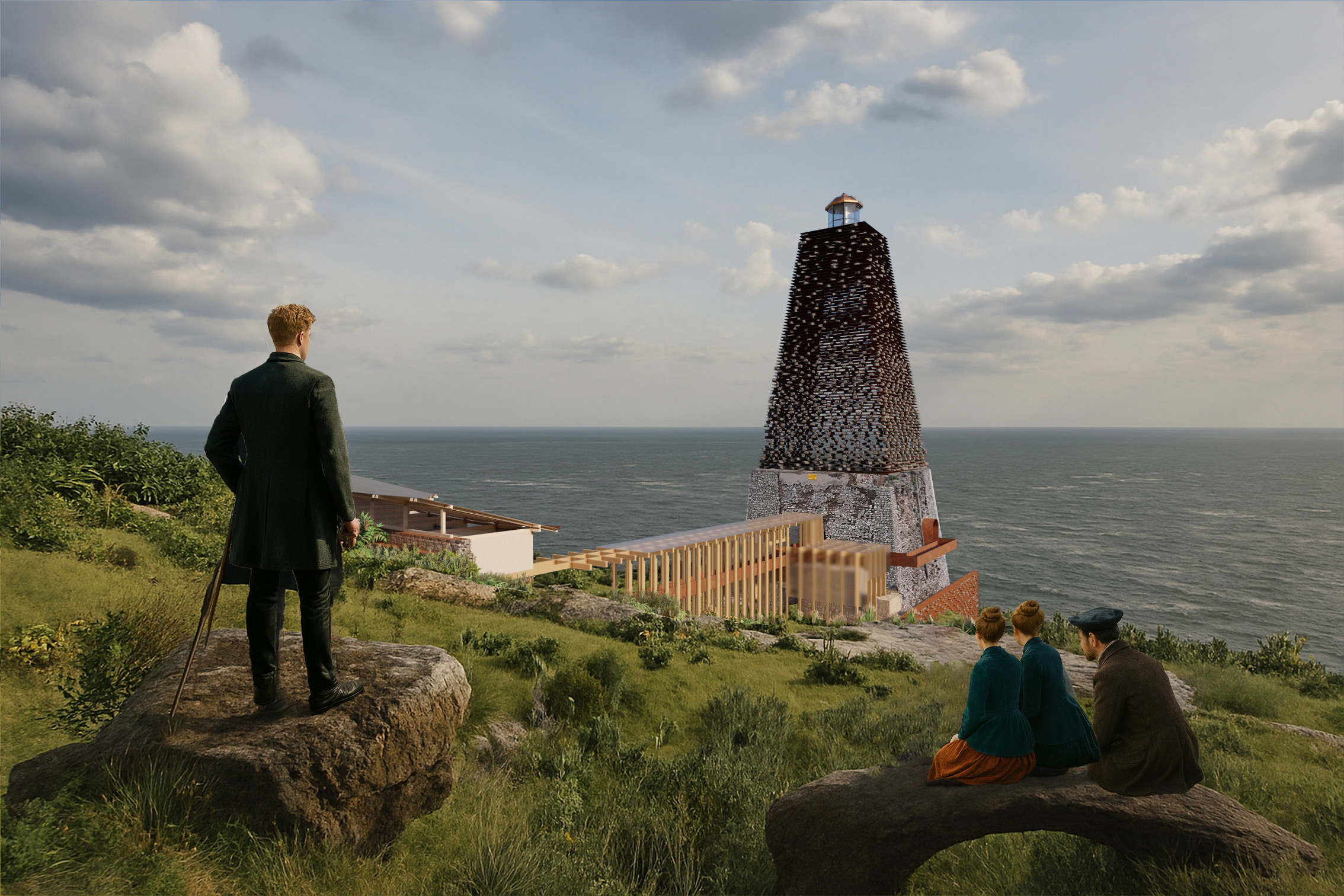
The Minerva Tower at Punta Campanella stands like a palimpsest: a stone sentinel whose silhouette has been read and reread by centuries of travelers, sailors, and the sea.
This project is a spatial inquiry into that act of reading — into how the tower is perceived across distance and proximity, how it performs as landmark, stage, guide, and memory and how new interventions might amplify those readings without effacing the traces that made them legible.
Rather than proposing an architectural whiteout, the design strategy takes the existing residues such as fallen masonry, collapsed parapets, the plinth of an old lighthouse and treats them as material memories to be honored and reactivated.
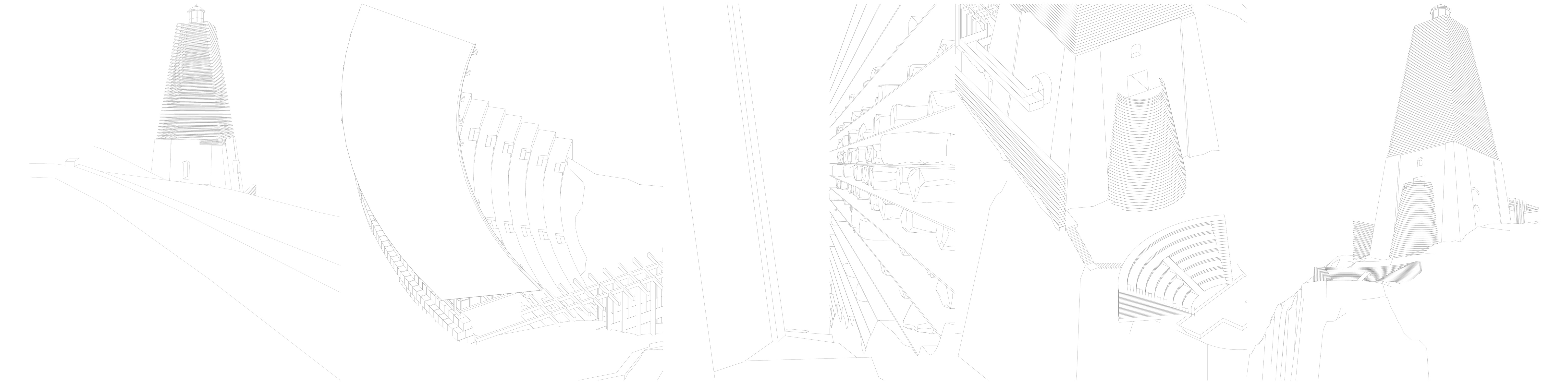
The proposal unfolds through five perceptual instances: Invitation, Termination, Guidance, Backrest, and Wayfinding.
Each instance corresponds to a mode of encounter and a modest architectural response that aims to heighten the tower’s capacity to speak to people and place.
Instance 1 — The Invitation (from afar)
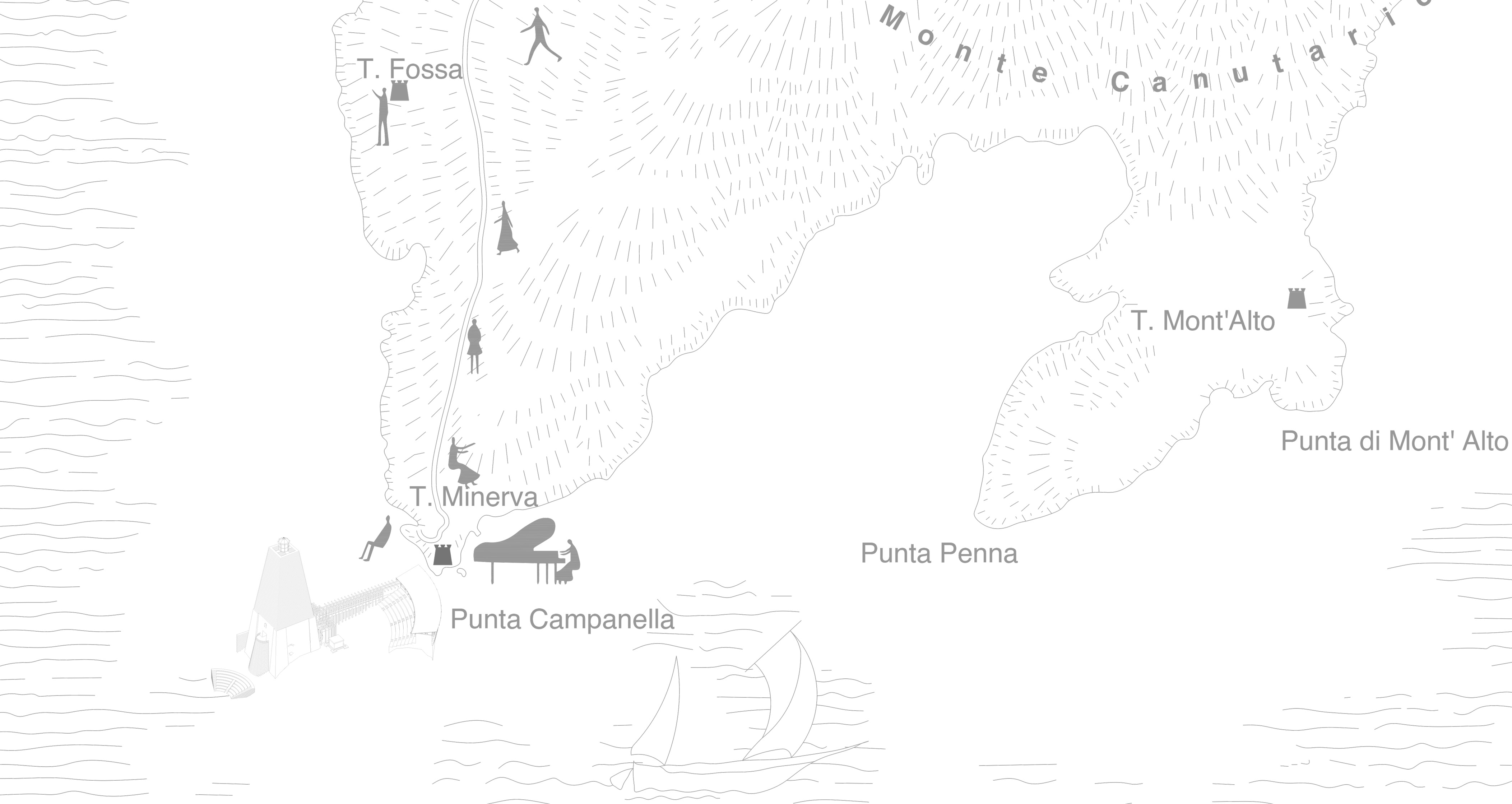
From the winding path of Via Minervia, the Minerva Tower first appears as a directional point and a punctuation mark on the Sorrento skyline that orders the traveler’s gaze. Set against the wide panorama of sea and headland, its first glimpse performs an invitation and a visual promise that something awaits at the end of the winding way.
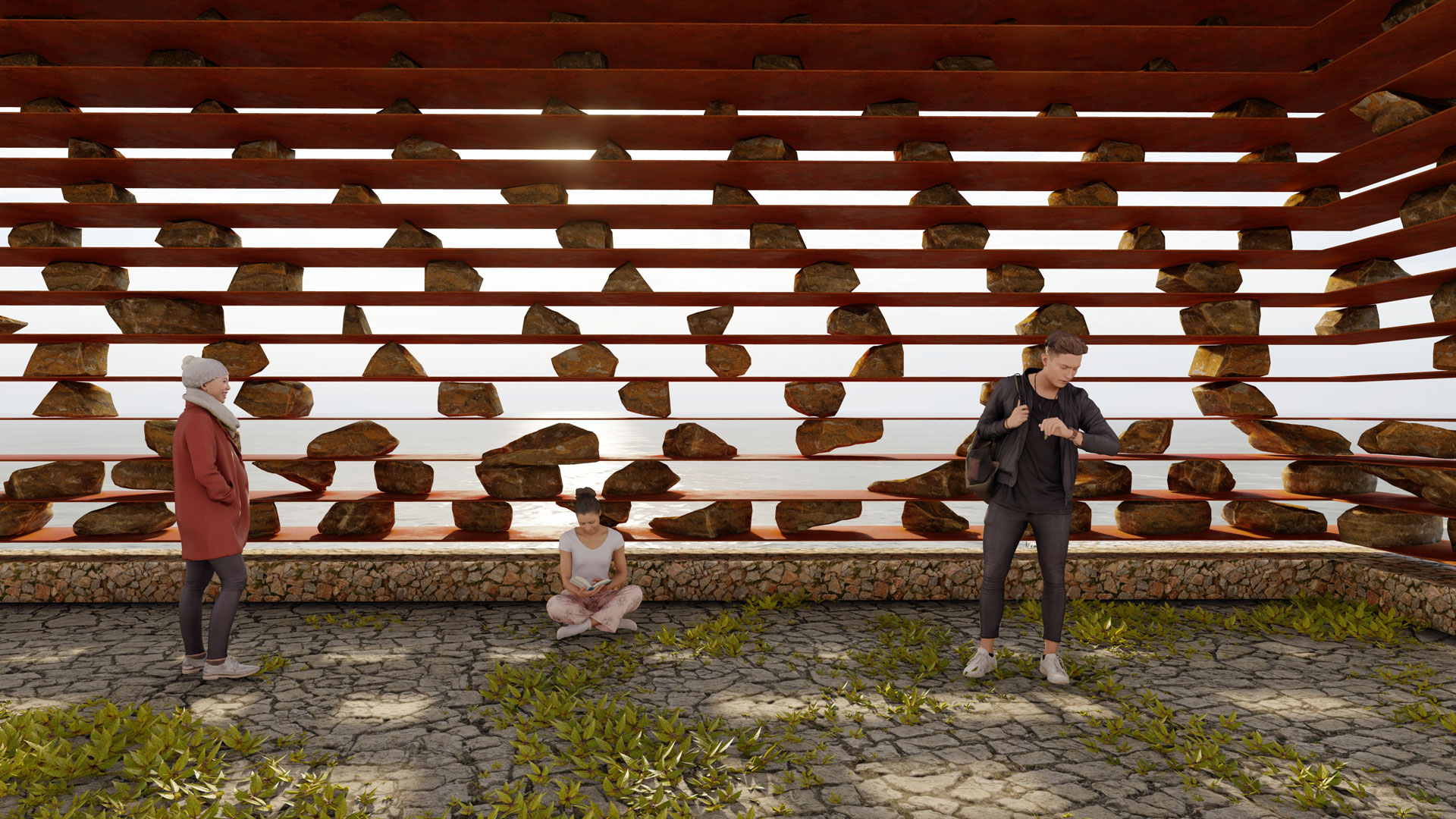
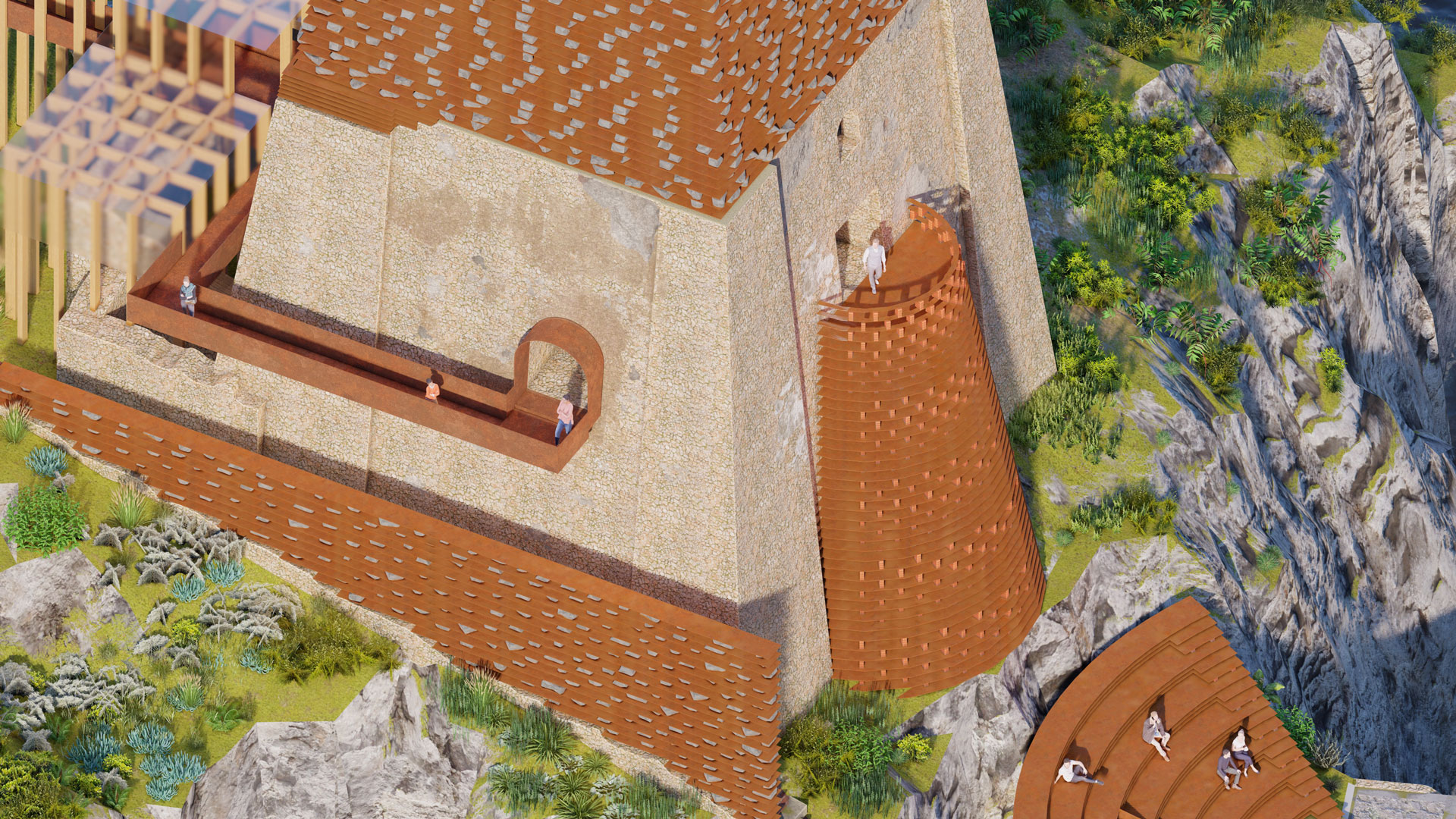
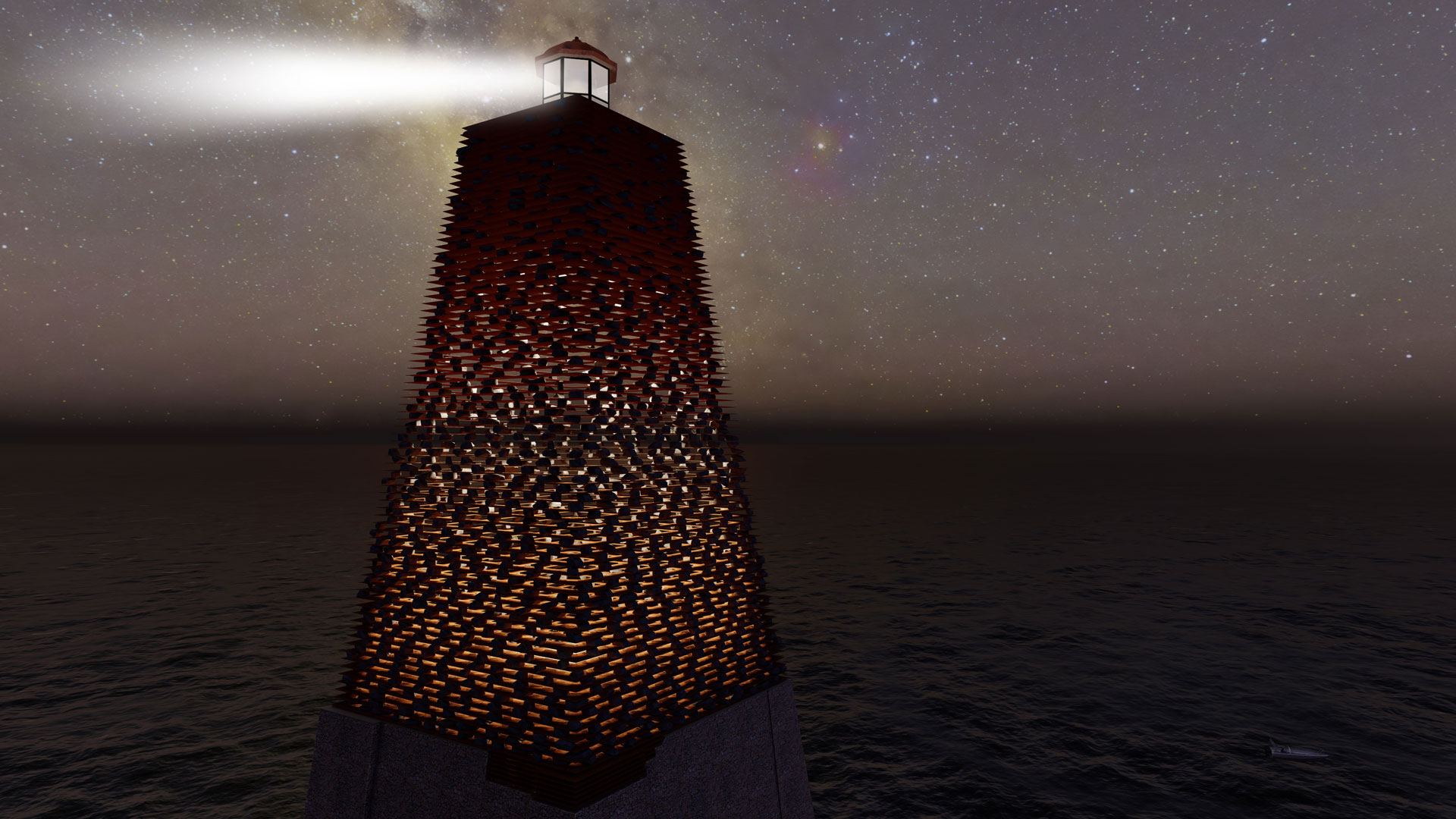
The architectural response treats this distant perception as an opportunity to dignify the fragments of the tower rather than conceal them. Rather than simply rebuilding, slender sheets of Corten steel are stacked vertically to extend the tower’s height like a mirage or a beckoning hand. Between these thin planks, the tower’s recovered stones are nested and held in careful suspension so that from some angles the tower reads as a stack of floating stones but from others as a shimmering vertical veil. The effect in a way is twofold : the extension reads as a contemporary gesture reachable by eye from the trail while the embedded stones keep the ruin’s material history visible, allowing memory to persist within a new tectonic grammar.
Instance 2 — The Termination (approach)
Closer now, the traveler treats the tower as the culmination of a journey. The path arrives and the hike ends. Here the tower’s role shifts from marker to destination.
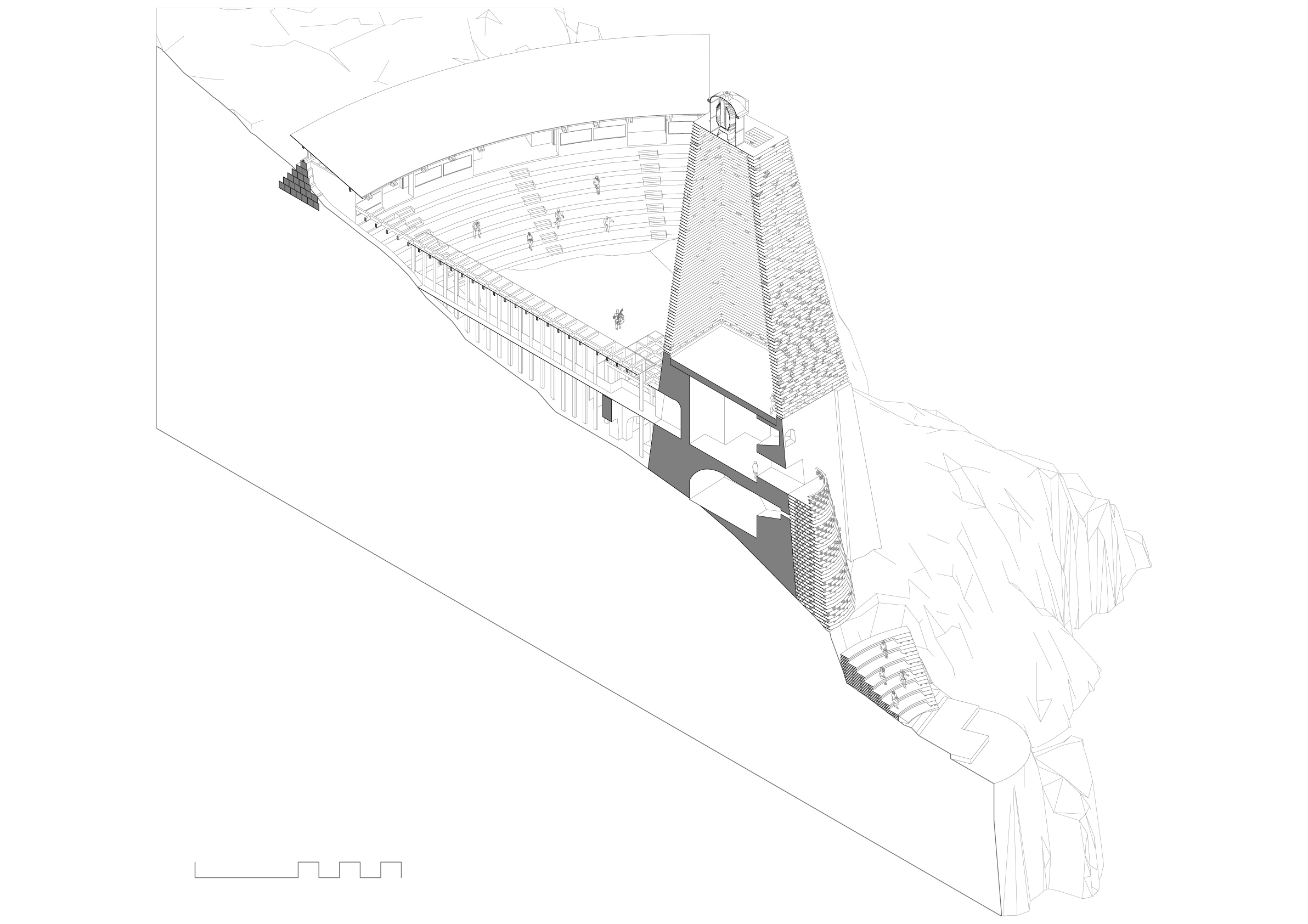
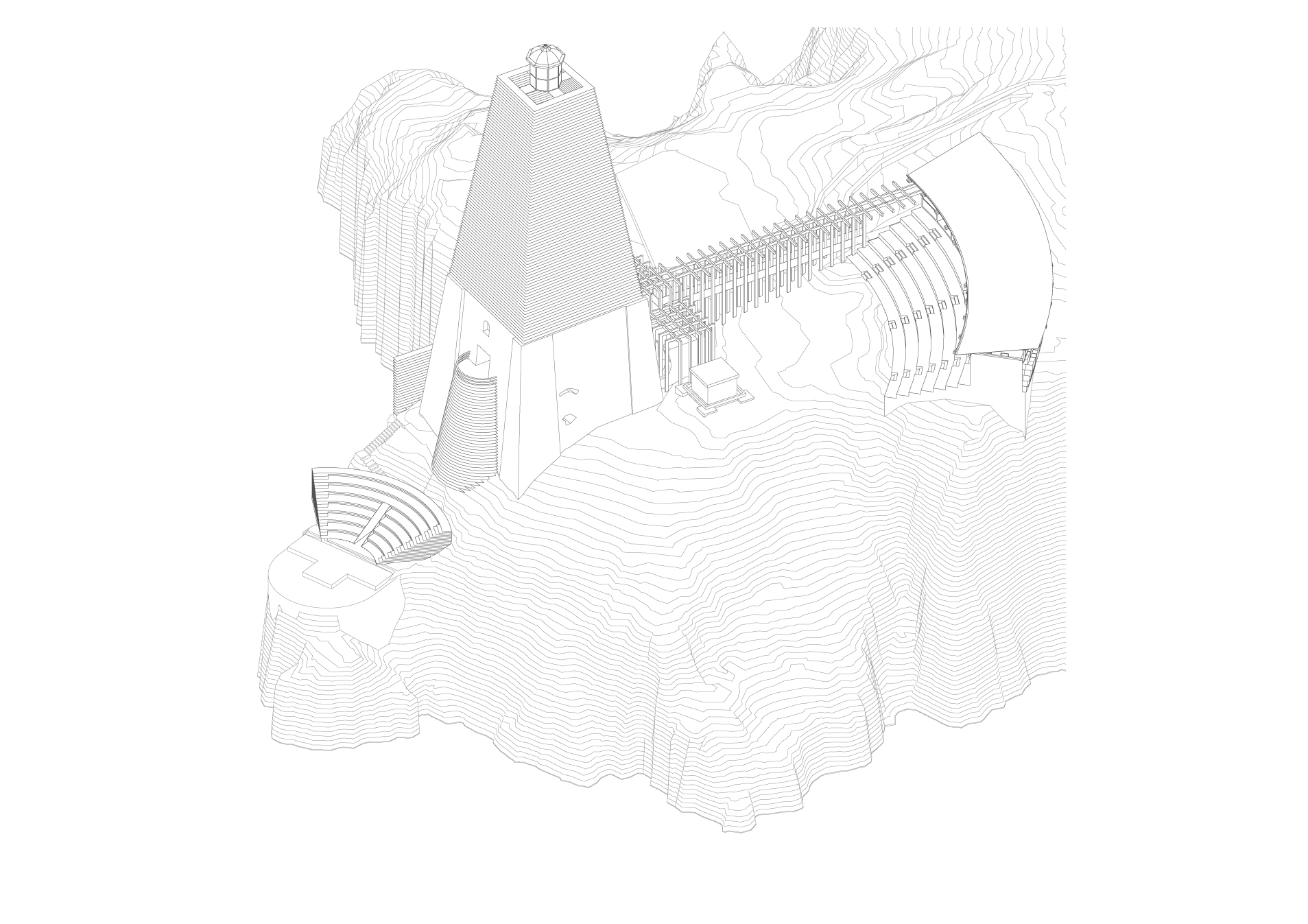
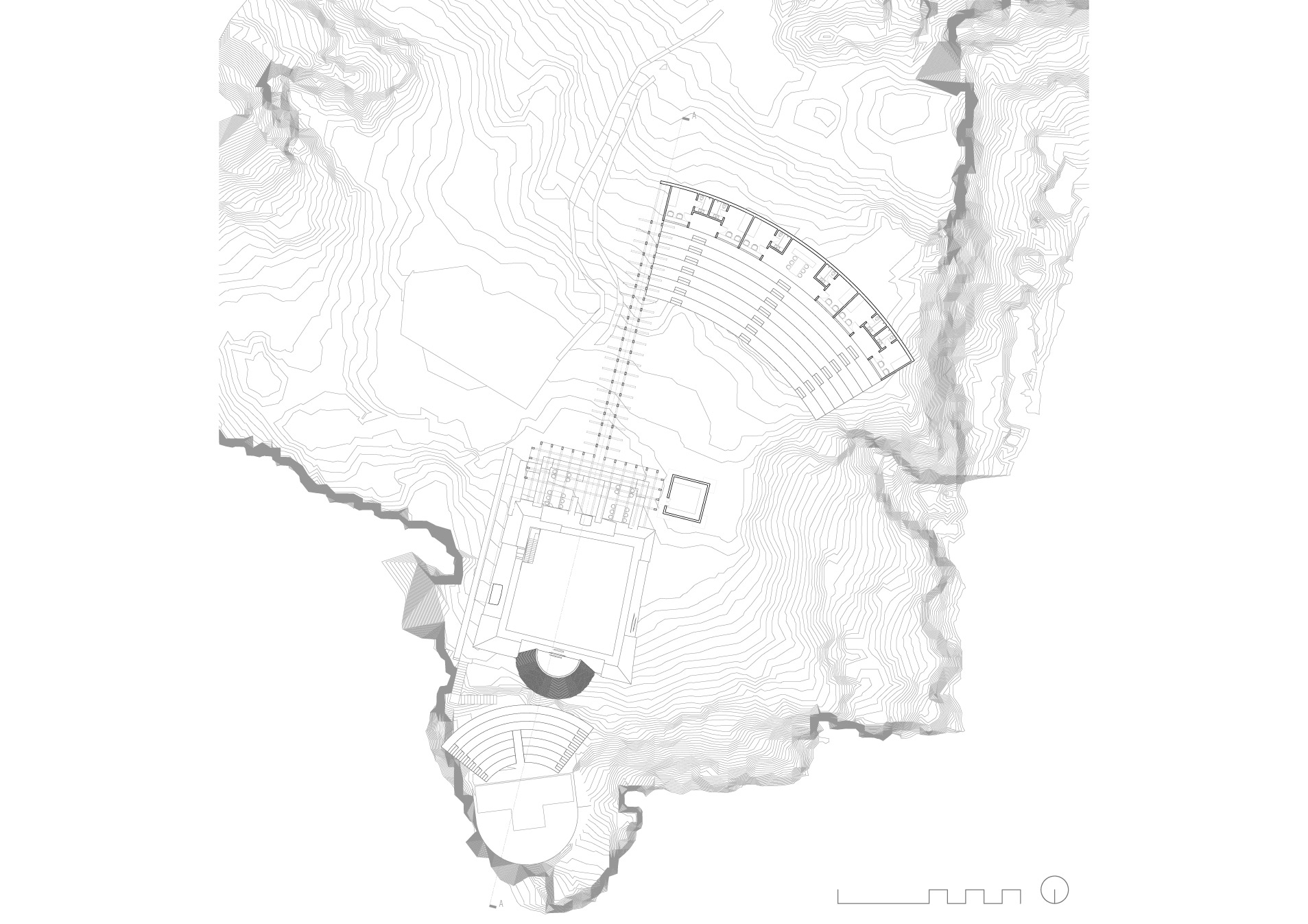
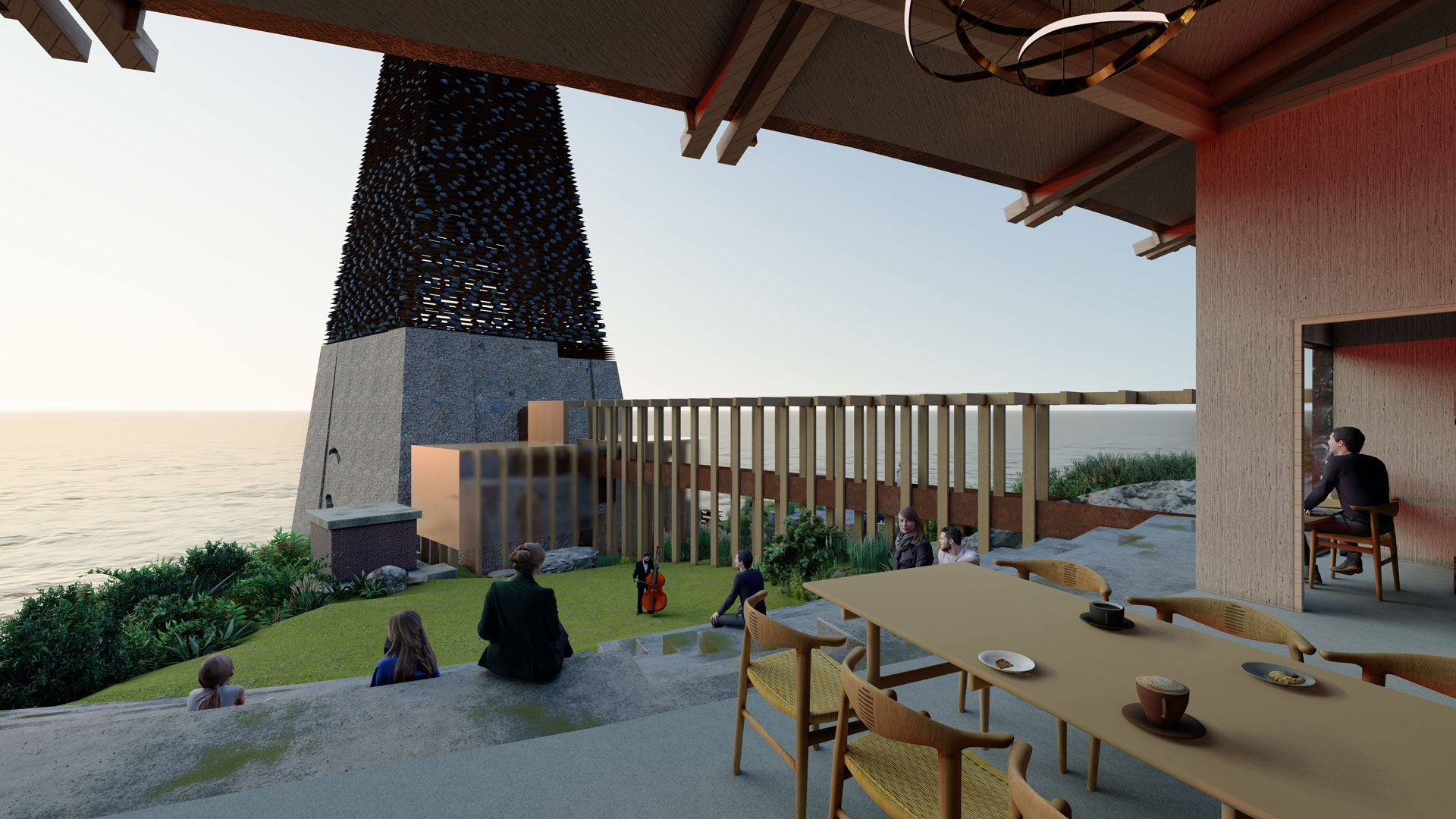
The design amplifies that sense of arrival with two complementary moves. First, a welcoming arm in the form of a wooden bridge that reads like a pergola which reaches from the slope to the original entrance and terrace, reconnecting fragmented thresholds and providing a clear and dignified approach. A peripheral steel bridge links to the first floor, making the ruin legible and accessible without erasing its weathered character.
Second, the immediate landscape is recomposed as a communal field and an artist residency is recessed behind a single radial gabion wall built from the site’s recovered stones. Lightweight wooden roofs shelter simple rooms oriented toward the tower and a central café anchors the small cluster. The slope becomes an amphitheatre with terraced benches carved from the contour. It positions the tower as a theatrical backdrop. In this formulation the tower does not merely end a path but it aslo completes a social ritual of rest, conversation and performance.
Instance 3 — The Guiding Element (extreme proximity)
At very close quarters the tower paradoxically loses its objecthood as its mass overwhelms vision and travelers moving alongside its walls may no longer apprehend its whole form. In this intimate scale, it becomes a guide which is less an object to behold but a seam to follow toward the sea.
To make this latent guiding quality explicit, the proposal repairs and extends the broken parapet with semi-transparent Corten planks interleaved with stone debris. The resulting enclosure, together with the tower’s original wall forms a long narrow passage that channels movement and sight toward the Tyrrhenian horizon. The material continuity between the new planks and the old masonry keeps the traveler oriented as they move with the tower as companion rather than merely past it. The narrow passage intensifies the experience of direction and here the tower’s presence becomes a line that urges the body onward.
Instance 4 — The Backrest (a sense of enclosure)
Emerging from that constricted lane the traveler is released into vast oceanic space. Descending the final steps as they stand before the wide sweep of sea and sky, the island of Capri punctuating the horizon.
Paradoxically, absence of the tower in the immediate view is itself generative and the tower becomes a remembered presence, a “backrest” that anchors the visitor physically and imaginatively. The design responds by creating an observation deck perched on the plinth of the former lighthouse as a low seat that reads as an elevated bench, supported by the recovered bricks and clad in the same language of steel and stone.
Here the visitor’s back is literally against the memory of the tower with their gaze propelled outward. The moment is structured for contemplation: the tower’s tectonic memory is behind the body, the panorama in front. The seat becomes a tiny stage for looking and a place where the site’s temporal sediments — ruin and reuse, remnant and addition — cohere into a single act of attention.
Instance 5 — The Wayfinding Element (from the sea)
Finally, the tower’s role beyond the land — its performance for sailors and the wider maritime landscape is acknowledged and continued. Historically a coastal guide, the watchtower and its lantern signaled location and safety to seafarers.
The proposal crowns the tower’s vertical extension with a functioning lantern and carves a circular platform recessed into the wall (a subtle nod to the 14th-century watch platform that once existed.) From the ocean, the tower resumes its ancient voice. A beacon, a point of reference. But the gesture is not nostalgic replication but rather a rearticulation of the tower’s communicative power in contemporary material terms. The new lantern and platform recall the tower’s civic and navigational purpose while being legible as present-day interventions.
Across these five moments, the project refuses the binary of preservation versus replacement. Instead it treats debris and ruin as raw material, not as objects of romantic ruinhood but as active agents in a process of remaking. Stones are not cast away; they are catalogued and re-embedded into gabions, plinths and infill that carry their history forward.
Corten steel — its warm patina echoing the earth tones of masonry — becomes a contemporary lingua franca that mediates between old and new: slender, light, and capable of transparency where weight would be crushing. Wood and glass provide shelter with tactility and lightness, protecting without enclosing memory.
Conceptually, the interventions operate as amplifications rather than erasures. Each intervention is calibrated to the scale and mode of perception at which the tower is encountered: from far-off invitation to intimate guidance, from communal termination to public wayfinding. The aim is not to produce a single grand architectural statement but to craft a sequence of modest, robust moves that intensify experiences already latent in the place.
In doing so the design honors Lefebvre’s insistence that space is sedimented: earlier forms underpin later ones, and representational narratives persist as layers beneath contemporary use.
The Minerva Tower thus becomes an anchor between material, memory, and place. Its stone fragments find dignity as part of new assemblages; its silhouette remains a call both for walkers on Via Minervia and sailors on the Tyrrhenian sea; its presence supplies both backdrop and threshold, backrest and beacon.
In the interplay between ruin and addition, permanence is not assumed but made — slowly, lightly, and with attention to the traces that give the place its meaning. The project imagines an architecture of continuity: one that listens to the sediments of time and, by doing so, makes room for future stories to be laid down on the land.